There’s a moment every candle maker runs into.
You pour a candle, let it sit overnight, and the next day you’re already wondering, “Can I test it yet?” The surface looks good, feels solid, and it smells good cold. So you decide to light it and then something feels off.
- The scent is weak.
- The burn doesn’t feel right.
- Or worse, you think the formula isn’t working at all.
But the truth is, nothing was wrong with your candle. It just wasn’t ready yet.
What “Curing” Actually Means
Curing isn’t just waiting for wax to harden.
It’s the time your fragrance oil needs to fully bind with the wax so the candle performs the way it’s supposed to when burned.
Without enough time:
- Scent throw can feel muted or uneven
- Burn performance can seem inconsistent
- Testing results don’t reflect the real outcome
So when you test too early, you’re not testing your formula—you’re testing an unfinished version of it.
Why Cure Time Isn’t One-Size-Fits-All
This is where things start to get confusing.
Different waxes behave differently:
- Soy-based waxes often need longer to fully develop scent
- Coconut blends tend to settle faster
- Paraffin can be ready sooner
- Beeswax can take more time to stabilize
And then you add fragrance load into the mix, and now timing isn’t just about the wax, it’s about your entire formula.
So instead of a single answer, you’re left with a range and that’s usually where people start guessing.
The Real Problem Isn’t Cure Time, It’s Tracking
Most people don’t struggle because they don’t know cure time matters.
They struggle because:
- They forget when they poured each batch
- They’re testing multiple candles at once
- They can’t remember which one is actually ready
- Everything starts blending together
At that point, even if you know you should wait. You don’t have a clear way to follow through and that’s where inconsistency starts.
What Changes When You Actually Track It
When you start tracking cure time, something shifts.
- You stop relying on memorizing it.
- You stop second-guessing.
- You stop testing “just to see.”
Instead:
- You know when each batch was poured
- You know how long it needs
- You know when it’s ready
And when you test, you’re finally testing something complete. Not too early and not rushed or uncertain. Just because your candle or batches are ready to test.
A Simple Way to Stay Consistent
You don’t need anything complicated. All you just need is a place where each batch lives outside your head.
Something that lets you:
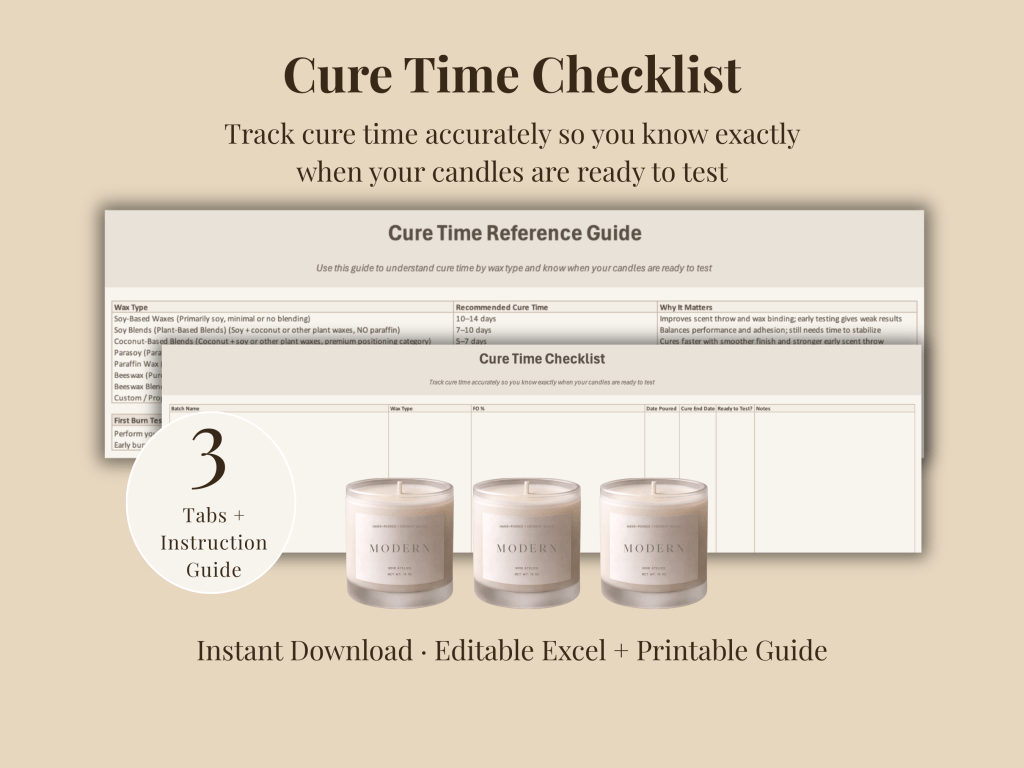
- log your pour date
- see your cure window
- mark when it’s ready
- keep notes as you go
Once that becomes part of your process, everything will be less stressful to track and remember.
If You Want a Clear Way to Do This
I have put together a simple Cure Time Checklist that does exactly that. It’s a clean way to track your batches so you know when to test and what to expect.
You can view the Cure Time Checklist here.
Conclusion
Candle making is about what you pour and when you test. Most of the time, the difference between “this isn’t working” and “this turned out exactly how I wanted” comes down to timing.
So the next time you finish a batch and feel tempted to light it early…
do you have the Checklist you need for it?
 Modern Digital By Kalia
Leave a comment