Choosing the right candle wax isn’t just about preference, it directly affects how your candle performs.
Scent throw, smooth tops, burn quality, and even how easy your candle is to make all depend on the wax you choose.
If you’ve ever tested a candle that didn’t turn out the way you expected, there’s a good chance the wax played a role.
This guide will help you understand the differences between common wax types so you can choose what actually works for your formula.
Why Wax Choice Matters More Than Most People Think
Not all waxes behave the same, even when everything else stays consistent.
The same fragrance oil, wick, and container can produce completely different results depending on the wax.
For example:
- Some waxes hold fragrance better but require more testing
- Some give smooth finishes but have a softer structure
- Others are easier to work with but may have lower scent throw
That’s why choosing a wax isn’t about what’s “best”, it’s about what fits your goal.
Common Candle Wax Types (And How They Compare)
Soy Wax
A popular choice for container candles. It’s easy to work with and widely available.
- Clean, natural look
- Moderate scent throw
- Can develop frosting
- Longer cure time
Coconut Wax (and Coconut Blends)
Often used for premium candles due to its smooth finish and performance.
- Creamy, smooth tops
- Strong scent throw
- Better adhesion to jars
- Higher cost
Paraffin Wax
Known for strong scent performance and ease of use.
- Strong hot throw
- Easy to wick
- Consistent results
- Less aligned with natural branding
Parasoy (Paraffin + Soy Blends)
Balances performance and usability.
- Stronger scent than pure soy
- Smoother finish
- More stable results
- Still requires testing for balance
Beeswax
A natural option with a distinct burn profile.
- Clean burn
- Long burn time
- Subtle natural scent
- Lower fragrance load capacity
The Problem Most Candle Makers Run Into
Most people don’t struggle because they lack information.
They struggle because:
- Information is scattered
- Advice conflicts
- Testing becomes trial and error
So instead of comparing waxes clearly, they:
- switch too often
- waste materials
- restart formulas repeatedly
A Better Way to Compare Wax Types
Instead of guessing or relying on memory, it helps to see everything in one place.
When you compare wax types side by side, you can:
- understand trade-offs clearly
- match wax to your specific goal
- narrow down your starting point before testing
That’s the difference between random testing and intentional testing.
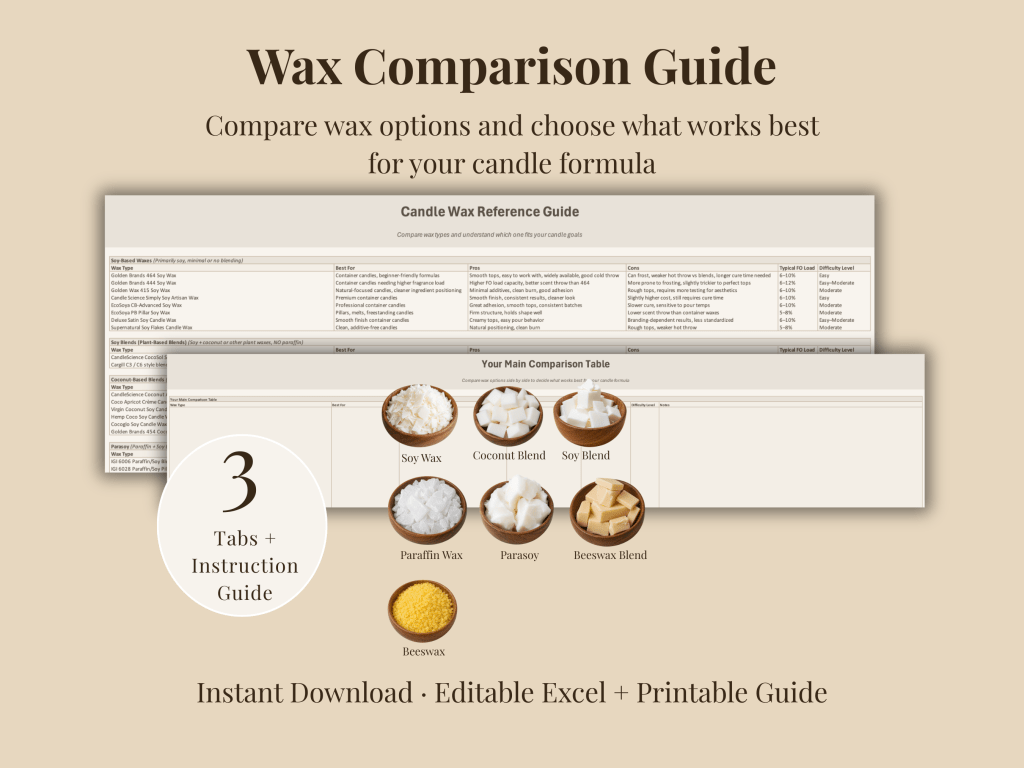
The Wax Comparison Guide (Excel + PDF)
To make this easier, I created a structured Wax Comparison Guide that lets you compare wax types in one place.
It includes:
- A full wax reference breakdown (best use, pros, cons, fragrance load, difficulty)
- A side-by-side comparison table to evaluate your options
- A built-in quick guide to match your goal with the right wax type
- A step-by-step PDF instruction guide to walk you through how to use it
This is designed to help you decide before you start testing — so you don’t waste time or materials on the wrong wax.
View the Wax Comparison Guide here.
When to Use This Guide
This guide is especially helpful when you:
- Are starting a new candle formula
- Want to switch wax types
- Are comparing performance differences
- Need a clearer starting point before testing
Conclusion
Choosing the right wax isn’t about finding a single “best” option.
It comes down to how each wax performs, what trade-offs you’re willing to work with, and how it fits into your candle formula.
When you can compare your options clearly, you’re not starting from scratch each time you’re making more intentional decisions before you even begin testing.
So before you pour your next batch, which wax actually makes sense for what you’re trying to create?
 Modern Digital By Kalia
Leave a comment